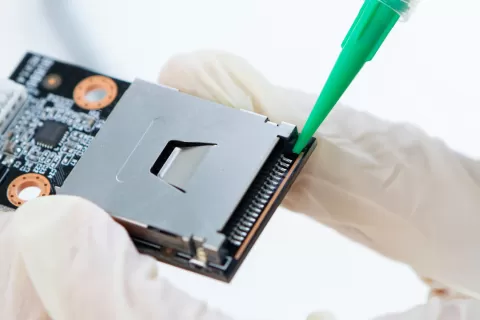
Underfill Encapsulants
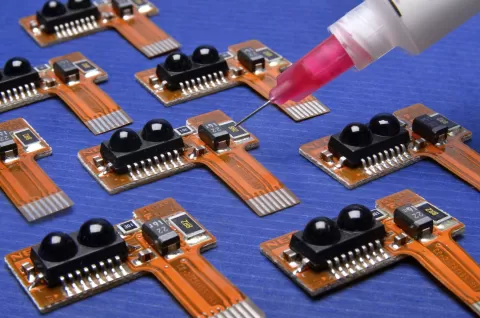
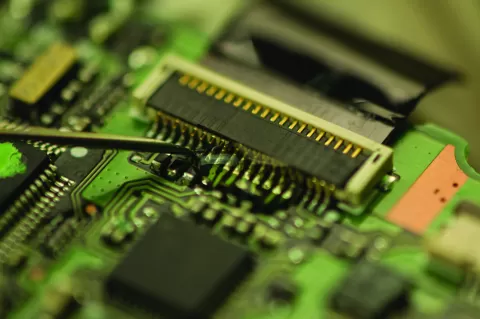
Designed to improve reliability, Master Bond’s line of epoxy underfill compositions offer excellent adhesion to die passivation as well as a variety of substrate materials. They enhance mechanical support, reduce strain on solder joints, and provide effective protection against moisture. As thermal and mechanical demands on modern assemblies continue to increase, managing stress within the package becomes increasingly important—requiring not only the right material, but also a clear understanding of how that stress is distributed.
How Underfill Redistributes Thermal Stress
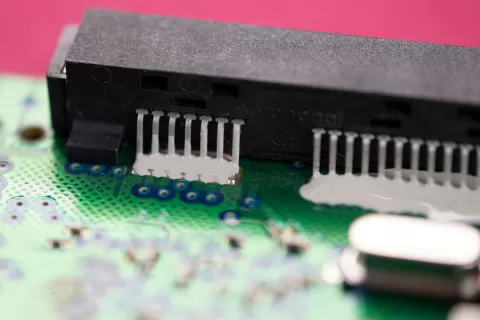
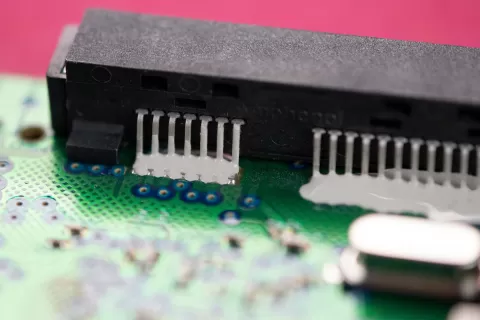
Underfill enhances the reliability of flip-chip and Chip Scale Packaging (CSP) assemblies by redistributing thermally induced shear stresses. These stresses arise from CTE (coefficient of thermal expansion) mismatch—silicon expands at ~2.6 ppm/°C, while organic substrates expand at 14–17 ppm/°C or even higher. The resulting differential movement is greatest at the die corners, placing the highest strain on outer solder joints. The underfill fillet that forms along the die perimeter is not just cosmetic. It is a key structural feature that helps redistribute stress and protect the interconnects during thermal cycling. Proper material selection—especially modulus, adhesion, and CTE—ensures this stress redistribution is effective over long-term thermal cycling. The effectiveness of this stress redistribution depends not only on the material properties of the underfill, but also on how the fillet is formed and controlled during processing.
Why Fillet Geometry and Volume Matter
The underfill fillet is not merely a byproduct of dispensing. It is a functional feature that directly influences reliability. Insufficient fillet volume may leave corner joints underprotected, increasing the risk of early failure under thermal cycling. Excessive volume, on the other hand, can lead to bleed-out, contamination, and downstream assembly challenges. Achieving consistent performance requires controlling both the material properties and the fillet geometry, ensuring adequate coverage without introducing process-related defects.
Advantages of Master Bond Underfill Systems
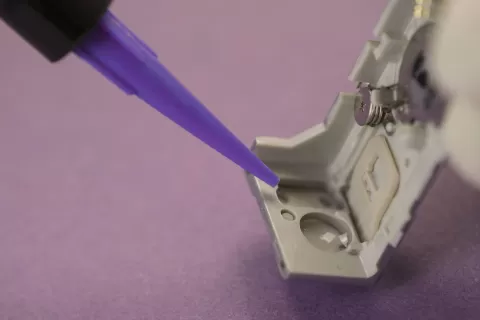
Master Bond underfill systems are engineered to manage thermally induced stresses while enabling precise control overflow, wetting, and fillet formation. Both flowable and non-flow systems are available. These specialty formulations support high-throughput manufacturing.
Key performance attributes include:
- High purity for sensitive electronic environments
- Low stress to minimize strain on solder joints
- High adhesion to a wide range of substrates
- Low coefficient of thermal expansion (CTE) for material compatibility
- Low outgassing for vacuum and enclosed applications
- High glass transition temperature (Tg) for thermal stability
- Optimized modulus for effective stress redistribution
- Moisture resistance for long-term durability
- Short cure cycles to improve production efficiency
- Structural stability under demanding conditions
- Excellent thermal cycling resistance
- Strong shock and vibration resistance
Our Most Popular Flip Chip Underfill Systems