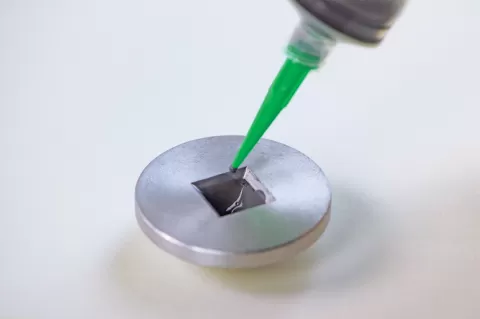
Master Bond EP55TCFL is available as either a two part or one part system, which will be described in more detail below. Regardless of the packaging, the cured properties are the same. Both are thermally conductive and electrically isolating, and can be used for bonding, sealing and coating. The system has a moderate viscosity that spreads evenly and smoothly when bonding. Curing is also the same, with two cure schedule options: 4-6 hours at 50-70°C or 3-4 hours at 80-90°C. The system has outstanding dimensional stability, no solvents or diluents, and low shrinkage upon curing.
The two part system is packaged in 1, 4, and 8 ounce jars and requires hand mixing with a ratio of 100:15 by weight. It should be stored in a refrigerator at 40–50°F and has a shelf life of 1-3 months. No special shipping conditions are required. The two part system is reusable and should be returned to the refrigerator for storage.
The one part system is premixed and frozen, packaged in syringes of 3 cc, 5 cc, or 10 cc for single use. It must be stored in a cryogenic freezer at –40°C and has a shelf life of 6 months. It is shipped at –40°C with dry ice. Prior to use, the syringe must be removed from the freezer and allowed to reach room temperature. Once thawed, it should not be returned to the freezer. Under no circumstances is the one part system reusable.
EP55TCFL bonds well to a variety of substrates such as metals, composites, ceramics and many plastics. It has good resistance to water, oils and fuels. It is gray in color, and has a service temperature range of -50°C to +125°C. The system is noteworthy for its toughness, low modulus and thermal cycling capabilities.
It has good flow properties which make it well-suited for small potting and encapsulation applications, where it can be applied in layers up to 1/4 inch thick.
EP55TCFL has a special thermally conductive filler with small particle sizes, which allows it to be applied in very thin bond lines. This results in lower thermal resistance and increases the heat transfer properties of the system. As such, it is a highly effective thermal interface material for bonding applications in microelectronic packaging and assembly.
Product Advantages
- High thermal conductivity and electrically insulating
- Good flexibility, withstands thermal cycling
- Versatile cure schedules
- Small particle size lowers thermal resistance
- NASA low outgassing