How To: Optimizing the Glass Transition Temperature (Tg)
When a polymer system such as an epoxy adhesive, potting compound or sealant is heated, significant changes occur in mechanical strength properties and thermal, electrical and chemical resistance which do not necessarily recover upon cooling. While these changes generally take place over a limited temperature range, a single temperature called the glass transition temperature (Tg) is generally selected for convenience.
Polymeric compounds, which are exposed to a temperature below the Tg, exhibit much higher physical strength and stiffness, as well as greater electrical insulation, dimensional stability and chemical resistance than they do above their Tg. Furthermore, performance upon structural loading is greatly enhanced. For convenience, the Tg is often considered the maximum sustainable operating temperature for a polymer system, especially in structural applications.
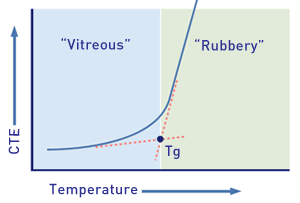 The Tg is measured by methods such as Differential Scanning Calorimetry (DSC), Dynamic Mechanical Analyzers (DMA) or Differential Thermomechanical Analyzers (DTA). It is greatly affected, not merely by the chemical composition of the epoxy compound, but by cure conditions such as time, temperature, specific response to heating, amount of load applied, degree of orientation and rate of testing. For many applications the Heat Deflation Temperature (HDT) (ASTM D 648-21, 1978) is utilized in place of Tg. This method employs castings with an applied load of 1.8 MPa (264 psi).
The Tg of epoxy adhesives, sealants and potting compounds varies from as low as 50°C to above 250°C. This offers a wide range of properties to best meet specific service conditions. The table below shows the Tg for some of the most widely employed Master Bond epoxy systems:
| Glass Transistion Temperatures For Selected Master Bond Epoxy Compounds | ||
|---|---|---|
| Product | Tg (°C) | Compound Description |
| EP21 | 50-80 | Two component, room temperature curing epoxy for general purpose, high performance bonding, sealing and coating. For service from -60°F to +250°F. |
| EP30 | 80-120 | Two part, low viscosity epoxy for coating, bonding and potting. Optically clear. Excellent insulator. For service from -60°F to +250°F. |
| EP42HT-2 | 120-150 | Low viscosity, room temperature curable, two component epoxy system. USP Class VI biocompatible. Withstands repeated autoclaving. Serviceable up to 450°F. |
| EP62-1 | 120-160 | Two part, heat and chemically resistant, oven curing epoxy. Superior electrical insulation properties. Serviceable from -60°F to +400°F. |
| Supreme 10HT | 130-160 | One part, heat cured (250-300°F) epoxy system with very high shear and peel strength and superb temperature resistance. Serviceable from cryogenic temperatures up to 400°F. |
| EP13 | 160-180 | One part, oven cured system (cures at 300°F) with excellent serviceability at higher temperatures, up to 500°F. |
| EP121CL | 200-250 | Two part, electrically insulative epoxy with excellent thermal stability and outstanding dimensional stability. For coating, sealing, potting, encapsulation and impregnation. For service up to 500°F |
| EP46HT-1 | 230-260 | Two part structural epoxy offering temperature resistance up to 550-600°F. Requires oven curing at 250-300°F. Unsurpassed chemical resistance. |
Careful selection of suitable Tg values for a proposed application is important to optimize the performance of an epoxy. Master Bond’s experienced technical staff will be glad to help you select the epoxy compound with the ideal blend of properties for your particular application.
Featured Products in this Tech Tip